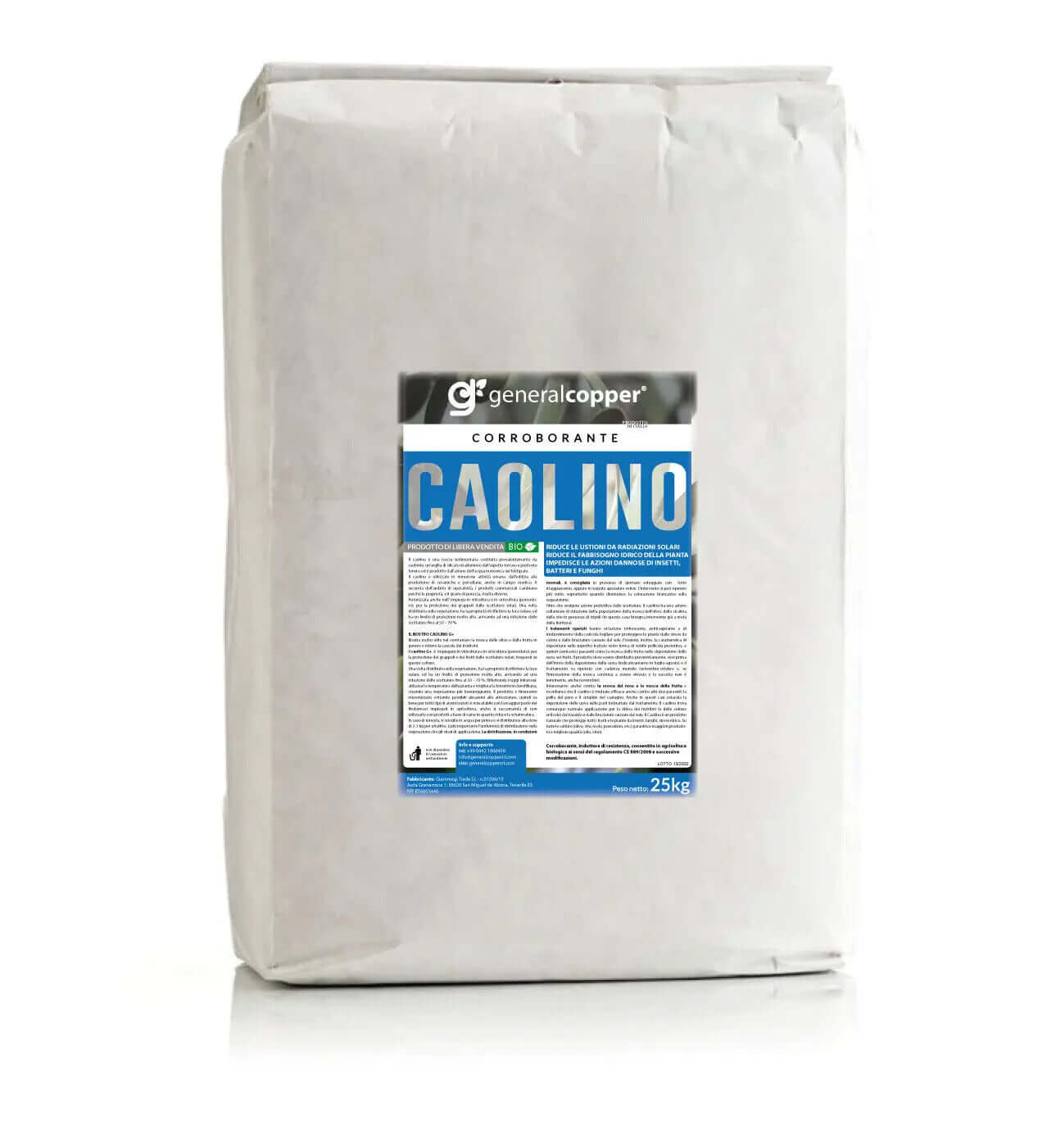
Kaolin corroborant natural defenses enhancer OLIVE FRUIT FLY 25 kg
Kaolin corroborant natural defenses enhancer OLIVE FRUIT FLY 25 kg
NATURAL DEFENSE BOOSTER AND ENHANCER FOR PLANTS
Composition: 100% rock powder
Product obtained as is from the mechanical grinding of kaolin free from pollutants
Characteristics
Rock powder is a dehydrating product, as it covers the plant with a film that counteracts the thermal effect, substantially reducing the wetting period of plant surfaces. The product also has an indirect physical effect on the development of phytophagous insects and fungal diseases.
Spray the vegetation evenly with an aqueous suspension of 2.5-4 kg/hl
Precautions for use
Rock powder in suspension is a natural product, harmless to humans, animals, and beneficial insects.
Store the container tightly closed in a dry, cool place, free from frost.
100% NATURAL KAOLIN POWDER PRODUCT
ALLOWED IN ORGANIC FARMING ACCORDING TO EC REGULATION 834/2007 AND SUBSEQUENT UPDATES
The characteristics of our formulation are:
- high micronization with particles smaller than 2 µm, so that it can be easily sprayed and adhere to the plant, possibly creating a film;
- the film does not interfere with gas exchanges and transmits photosynthetically active radiation while reducing ultraviolet and infrared radiation, but it interferes with and hinders insect activity;
- it does not create difficulties for the harvested product, as it is easily removed
It is very useful in combating the olive and fruit fly in general and reducing fruit drop.
Kaolin (white clay) is used in viticulture and horticulture (tomato) for the protection of bunches and fruits from sunburn, which are frequent in these crops.
Once distributed on the vegetation, it has the property of reflecting sunlight, and has a very high level of protection, achieving a reduction in sunburn of up to 50 – 70%. By reflecting infrared rays, it lowers the plant's temperature and improves chlorophyll photosynthesis, creating more lush vegetation. The product is finely micronized, avoiding possible abrasion to equipment, so it is suitable for all types of atomizers; it is miscible with most plant protection products used in agriculture, although it is recommended not to use it with copper-based products as it reduces screening.
In case of mixing, it is dissolved in water first and then distributed at a dose of 2-3 kg per hectoliter.
Uniformity of distribution on the vegetation is more important than the application layers. Treated plants have a whitish-milky leaf surface but are easily washed away by heavy rainfall.
Distribution, under normal conditions, is recommended on sunny days with strong irradiation, or after summer pruning. The treatment can be repeated multiple times, especially when the whitish coloration on the vegetation decreases.
In addition to providing protection from sunburn, kaolin has a collateral effect of reducing the population of the olive fly, the vine leafhopper in the presence of thrips (in this case, intervention should begin in mid-flowering).
Repeated treatments have a refreshing, antitranspirant, and strengthening effect on the leaf cuticle to protect plants from heat stress and sun damage. It also has the characteristic of depositing on treated surfaces as a thin protective film, and thus combats pests such as the fruit fly in laying eggs on fruits. The product must be distributed preventively, i.e., before the start of egg-laying (approximately in July-August) and the treatment should be repeated monthly (September-October and, if the fly infestation continues to be high and harvesting is not imminent, also November).
The use of kaolin is allowed in organic farming.
Also interesting against the walnut fly and the fruit fly, and we remember that kaolin has also been found effective against two other pests: the pear psylla and the chestnut gall wasp. In these cases too, it hinders egg-laying on the parts contaminated by the treatment.
Kaolin is in any case normally applied for the defense of fruit trees (and horticultural crops) from scorching and burns caused by the sun.
mixing tips:
do not dissolve the product directly in the correct amount of water but prepare a paste with a little water and then gradually mix it with the remaining water (dose per liter)
Share