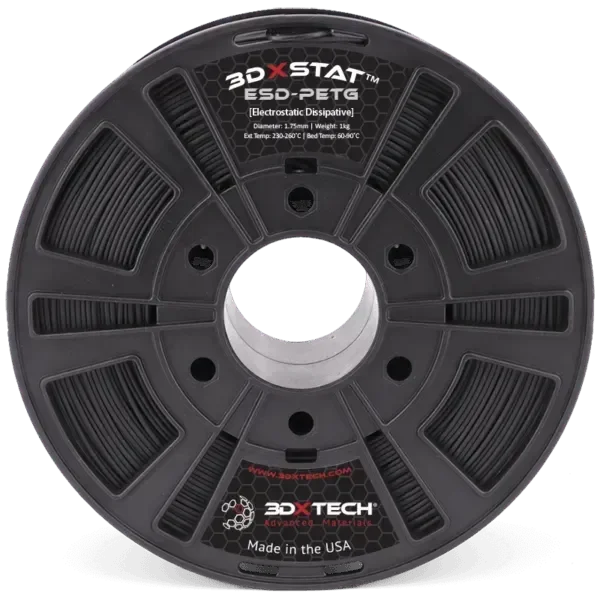
3DXTECH STAT™ ESD-PETG 1.75mm/750g
3DXTECH STAT™ ESD-PETG 1.75mm/750g
3DXSTAT ESD-PETG is an easy-to-use ESD-Safe filament formulated for a broad range of applications that require electrostatic discharge (ESD) protection and increased chemical resistance. Made using high-flow PETG copolymer and CNT to provide exceptional repeatability and reliability.
3DXSTAT ESD-PETG
3DXSTAT ESD-PETG is an advanced anti-ESD compound designed for use in critical applications requiring electrostatic discharge (ESD) protection. Made using cutting-edge multi-wall carbon nanotube technology, state-of-the-art compounding technology, and precision extrusion processes. Target surface resistance of 107 to 109 Ohm.
PETG benefits include:
- Superior chemical resistance vs. ABS
- Amorphous structure giving low, near-isotropic shrinkage
- Low moisture absorption, 3x lower than ABS
- Very low odor emitted during printing
- Superior ductility vs. ABS
- Wide processing range of 230-260°C
3DXSTAT™ benefits include:
- Consistent surface resistivity
- Improved impact and elongation retention
- Low particulate contamination
- Minimal contribution to outgassing and ionic contamination
PETG chemical resistance:
Unstressed tensile bars printed in PETG show good resistance to dilute aqueous solutions of mineral acids, bases, salts, and soaps, and to aliphatic hydrocarbons, alcohols, and a variety of oils. Halogenated hydrocarbons, short-chain ketones, and aromatic hydrocarbons dissolve or swell the plastic.
Typical ESD-PETG applications include:
- Semi-con: HDD components, wafer handling, jigs, casings, and connectors
- Industrial: Conveyance, metering, and sensing applications
Target conductivity for 3DXSTAT ESD-PETG:
- 107 to 109 ohm surface resistivity on 3DP sample using concentric ring test method.
- Note: Internal studies have indicated that increasing the extruder temperature can achieve higher levels of conductivity. Likewise, lower extruder temperatures resulted in lower levels of conductivity. Every printer is set up differently as well as part geometry varies. Therefore, expect some trial time to understand how this filament works in your specific printer/application. However, do not exceed 270°C to reduce the risk of polymer degradation.

Surface conductivity as a function of extruder temperature:
The surface resistance of the printed ESD protective part varies with the extruder temperature of the printer. For example, if testing indicates that the part is too insulating, increasing the extruder temperature will result in better conductivity. Therefore, the surface resistance can be "tuned" by adjusting the extruder temperature up or down depending on the reading you receive from your side.
Recommended print settings:
- Extruder: 230-260°C
- Bed temperature: 60-90°C
- Bed preparation: Magigoo Bed Prep adhesive and 3DXTECH polyimide tape
- Heated chamber: not required
- Supports: AquaTek X1 USM water-soluble works perfectly for complex parts.
- Drying instructions: 65°C for 4 hours.