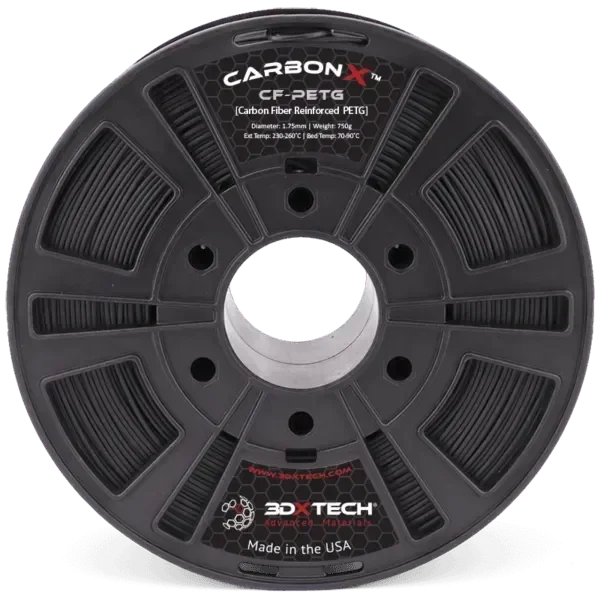
3DXTECH CARBONX™ PETG+CF 1.75mm/750g
3DXTECH CARBONX™ PETG+CF 1.75mm/750g
CarbonX PETG+CF Carbon Fiber Reinforced Co-Polyester
CarbonX PETG+CF is made in the USA using premium PETG and a high modulus carbon fiber (not carbon powder or milled carbon fiber). CarbonX PETG+CF is a CF reinforced 3D printing filament improved over the competition. This filament is ideal for anyone who desires a structural component with high modulus, excellent surface quality, dimensional stability, light weight, and ease of printing.
Benefits of CarbonX™ PETG+CF include:
- Superior chemical resistance vs. ABS
- Amorphous structure results in low, near isotropic shrinkage
- Low moisture absorption, 3x lower than ABS
- Very low odor while printing
- Wide processing range from 230-270°C
PETG Chemical Resistance:
Unstressed tensile bars molded from PETG show good resistance to dilute aqueous solutions of mineral acids, bases, salts and soaps, and to aliphatic hydrocarbons, alcohols, and a variety of oils. Halogenated hydrocarbons, short‐chain ketones, and aromatic hydrocarbons dissolve or swell the plastic.
Recommended Print Settings:
- Extruder: 230-260°C
- Bed Temp: 70-90°C
- Nozzle: We currently recommend a hardened steel nozzle with a minimum diameter of 0.4mm.
- Other: Ideal layer height is 60% of nozzle diameter. We do not recommend printing layers below 0.2mm with carbon fiber reinforced filaments.
- Bed Prep: Magigoo Bed Prep Adhesive
- Heated Chamber: Not required
- Supports: AquaTek X1 USM Water Soluble works great for complex parts.
- Drying Instructions: 65°C for 4 hours.
Carbon Fiber Reinforced Filament
What is it? - Chopped Carbon Fibers are 5-10 micrometers in width. The fibers are aligned along the axis of the material. This, along with their physical composition, is what gives this material its excellent properties.
What does it do? - Carbon fibers demonstrate many desirable material properties: high stiffness, high tensile strength, high heat tolerance, high chemical resistance, low weight, and low thermal expansion
How does it work? - Reinforcing plastic with carbon fibers produces a 3D printing filament that boasts the best properties of both the carbon fibers and the chosen plastic.
What is it good for? - Ideal for any application that requires light weight and high stiffness. Carbon fiber reinforced parts, designed to use less material and save weight, are extremely popular in aerospace, civil engineering, military, and motorsports.
Abrasive Material
This material is particularly abrasive among 3D printing filaments. Users may find that standard brass nozzles are chewed through very quickly compared to standard wear and tear. Once worn, the nozzle orifice will become wider in an inconsistent fashion and the printer will experience extrusion issues.
Because of this, it is highly recommended to print this material through a hardened steel nozzle instead of with a softer metal. Hardened steel nozzles can often be inexpensive and easy to install, depending on your printer manufacturer's instructions.
Share