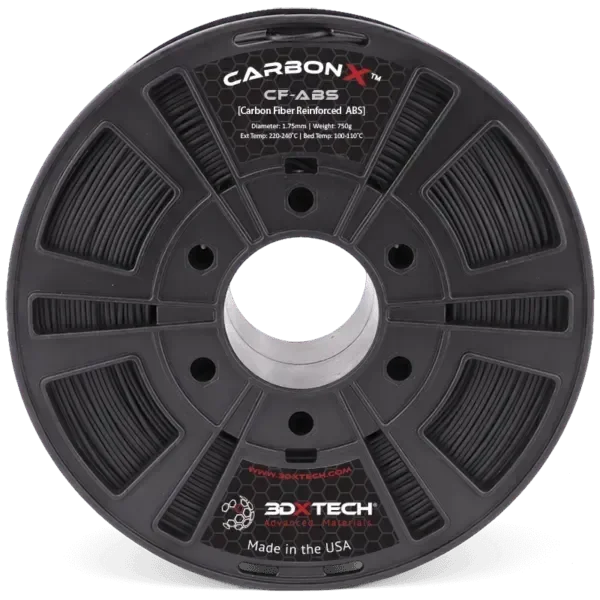
3DXTECH CARBONX™ ABS+CF 1.75mm/750g
3DXTECH CARBONX™ ABS+CF 1.75mm/750g
CarbonX ABS+CF Carbon Fiber Reinforced ABS
CarbonX ABS+CF is a high-performance carbon fiber reinforced ABS filament ideal for anyone desiring a structural component with high modulus, excellent surface quality, dimensional stability, light weight, and ease of printing. Made using 10% high-modulus carbon fiber. Manufactured in the USA using premium Sabic MG-94 ABS and premium high-modulus carbon fiber.
Benefits of CarbonX™ ABS+CF include:
- Stiff, high-modulus, industrial-grade parts from many 3D printers available today
- Greatly improved stiffness, modulus, and dimensional stability due to the addition of carbon fiber reinforcement
- Easier to print than most industrial-grade materials
- Parts can be smoothed using acetone vapor
- Higher melt temp than PLA or PETG
Recommended Print Settings:
- Extruder: 220-240°C
- Bed Temp: 100-110°C
- Nozzle: We currently recommend a hardened steel nozzle with a minimum diameter of 0.4mm
- Other: Ideal layer height is 60% of nozzle diameter. We do not recommend printing layers smaller than 0.2mm with carbon fiber reinforced filaments.
- Bed Prep: Magigoo Bed Adhesion
- Heated Chamber: Recommended, a chamber helps reduce warping.
- Supports: AquaTek X1 USM water soluble works great for complex parts.
- Drying Instructions: 80°C for 4 hours.
Carbon Fiber Reinforced Filament
What is it? - 5-10 micron wide carbon fibers. The fibers are aligned along the axis of the material. This, along with their physical make up, is what gives this material its excellent properties.
What does it do? - Carbon fibers demonstrate many desirable material properties: high stiffness, high tensile strength, high heat tolerance, high chemical resistance, light weight, low thermal expansion,
How does it work? - Reinforcing plastics with carbon fibers produces a 3D printing filament that exhibits the best properties of both carbon fibers and the chosen plastic.
What is it good for? - Ideal for all applications that require light weight and stiffness. Carbon fiber reinforced parts, which are designed to use less material and save weight, are extremely popular in aerospace, civil engineering, military, and motorsports.
Abrasive Material
This material is particularly abrasive among 3D printing filaments. Users may find that standard brass nozzles are chewed through very quickly compared to standard wear and tear. Once worn, the nozzle diameter will widen inconsistently, and the printer will experience extrusion problems.
For this reason, it is highly recommended to print this material through a hardened steel nozzle instead of softer metal. Hardened steel nozzles can often be inexpensive and easy to install, depending on the printer manufacturer's instructions.
Share